






AG Dr. Gabriel Ziegler: Modelling & Neuroprognosis in Ageing and Dementia
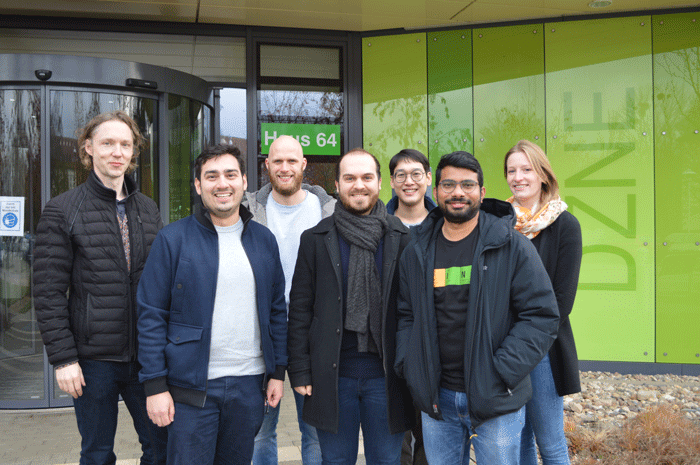
Modelling & Neuroprognosis in Ageing and Dementia
Research Group of Dr. Gabriel Ziegler (MNG)
Institute of Cognitive Neurology and Dementia Research (IKND), University Hospital Magdeburg ·
German Center for Neurodegenerative Diseases (DZNE) Magdeburg
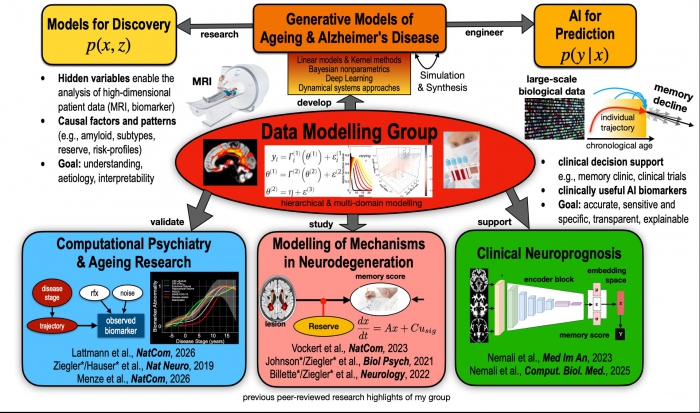
Group profile at a glance: data domains (deep phenotyping and multimodal imaging), the methodological pipeline represent → locate → explain → decide, and target cohorts and applications.
Overview
The Modelling & Neuroprognosis Group (MNG), led by Dr. Gabriel Ziegler at the Institute of Cognitive Neurology and Dementia Research (IKND, University Hospital Magdeburg) and the German Center for Neurodegenerative Diseases (DZNE Magdeburg), develops quantitative, generative, model-based and machine-learning methods for ageing and neurodegeneration. Our mission is principled statistical and AI-driven inference on multi-domain data of the ageing and diseased brain that turns heterogeneous imaging and clinical measurements into calibrated, individual-level predictions (neuroprognosis).
We are a methods-first group with a deliberately broad technical footprint: probabilistic and Bayesian machine learning, multivariate and latent-variable approaches, deep generative models (variational autoencoders, foundation models), dynamical-systems and ODE modelling, normative and disease-progression modelling, causal inference, and decision theory. Our work involves multi-modal neuroimaging (structural, functional, microstructure, diffusion) and non-imaging domains (neuropsychology, CSF/plasma biomarkers, lifestyle, genetics) with a strong emphasis on relationships (A) across neuro-cognitive domains; and (B) over time, making the MNG an attractive partner for both methodological and clinical collaboration.
Our work primarily focuses on well-characterised large-scale neuroimaging cohorts, including DZNE-DELCODE (longitudinal memory-clinic cohort along the Alzheimer’s continuum) and various other multi-centric studies such as ADNI, A4, IXI, OASIS, NIH and local clinical cohorts. We address recurring methodological challenges such as small-to-moderate sample sizes (n ≲ 10³), missingness, sparsity, multi-centre confounds and multimodality: methods must be sufficient, invariant to nuisance, calibrated and identifiable, not merely accurate on paper.
What we do: Four methodological pillars
Our research is organised as a pipeline: represent → locate → explain → decide. Two cross-cutting themes with a) transportability (research-to-clinic transfer) and b) calibration & identifiability (trustworthy uncertainty) run through all four pillars.
1. Representation learning Generative & latent-variable models
Finding data representations that facilitate clinical understanding and enable excellent predictions at the same time is challenging but tractable when guided by optimality principles of compression (Poldrack, 2026, Ma et al., 2022). Our group aims to learn compact, probabilistic representations/embeddings of high-dimensional brain and clinical data. This spans unsupervised deep generative models for structural MRI (e.g. variational autoencoders; Nemali et al., Comp. Biol & Med., 2025, Bernal-Moyano et al., in prep.), supervised learning of downstream prediction tasks (Nemali et al., Medical Image Analysis, 2023), calibrated low-sample encoders for tabular clinical data (in the spirit of tabular foundation models), and multimodal fusion (Suksangkharn et al., in prep.) combining unimodal embeddings versus learning genuinely joint representations across imaging, fluid biomarkers and cognition. Where possible we also exploit existing medical foundation models rather than training from scratch, a design choice dictated by the small-sample regime. Methods: VAEs, group factor analysis, sparse PLS/CCA (Ziegler et al., 2013), frozen foundation-model encoders.
2. Trajectory inference Normative & disease-progression modelling
We quantify where an individual neuro-cognitive phenotype lies relative to a healthy reference and how that position evolves over time; normative modelling is treated as the static (time-marginal) special case of trajectory inference. Methods: Gaussian-process normative models (Ziegler et al., 2014), Bayesian mixed-effects (Ziegler et al., 2015) and latent-time disease-progression models (Lattmann et al., NatComs, 2026), and subtype-aware mixtures. Applications include population reference models on healthy aging cohorts and subtype-aware continuous disease progression modelling. Characterising individual change in healthy ageing involves multi-domain longitudinal models that integrate brain morphometry, vascular lesions and cognitive decline and facilitate the quantification of individual neuro-cognitive maintenance (Menze et al., NatComs, 2026).
3. Mechanism: Causal & counterfactual dynamical models
We move from description to mechanism using generative dynamical-systems (ODE) models and counterfactual inference. For this purpose we use network-diffusion and mechanistic ODEs for disease spread, and counterfactual intervention models for “what-if” reasoning (Chen et al., 2018; Schölkopf et al., 2021; Pearl, 2019). Continuous-time mechanistic modelling approaches have led to applications in brain development (Ziegler et al., 2017), neurodegeneration in Huntington’s disease (Johnson*/Ziegler* et al., Biol. Psych, 2021) and Alzheimer’s disease (Schwarck et al., MADM, 2024). From this mechanistic perspective, cognitive reserve can be reframed as moderation of the structure-to-cognition mapping (Vockert et al., NatComs, 2024). In addition to conditioning individual cognitive decline in ageing/AD or behavioural traits in development on the brain’s macro-structure (Heinzinger et al., ART, 2023), vascular brain health (Menze et al., ART, 2024, Bernal-Moyano et al., ART, 2024), brain microstructure (Ziegler*/Hauser* et al., Nat Neuroscience, 2019, Ziegler*/Moutoussis* et al., 2020), we recently studied effects of AD pathology on model-based effective connectivity changes in task fMRI (Suksangkharn et al., ART, 2026).
4. Decision-theoretic inference Value of information
Finally, we ask how to (1) establish data-driven, model-based and calibrated beliefs about a patient’s state in ageing and preclinical disease progression; and (2) convert these beliefs into principled actions and measurement policies for clinical decision support: Which probabilistic statements about a patient’s future are justified given sparse available information, and which clinical measurement next (MRI scan, blood, CSF sample, etc.), at what cost, which interventions (if suitable)? For this we apply supervised learning to the above representations, methods of Bayesian decision theory and the economics of clinical information (Howard, 1966; Ades et al., 2004). Biomarker cost, cheap/less-invasive versus expensive/invasive assays/MRI/PET, enters as a value-of-information variable, directly relevant to affordable, prognosis-guided diagnostic pathways.
Cross-cutting strengths
- Transportability & harmonisation: invariant, causal features that generalise across scanners, sites and cohorts (research → clinic; e.g. DELCODE → ADNI / external cohorts).
- Calibration & identifiability: distribution-free (conformal) calibration of posteriors and counterfactuals (Angelopoulos & Bates, 2023); a prerequisite for trustworthy staging, trial design and clinical decision support.
AI & machine-learning expertise
MNG is, at its core, an AI methods group applied to brain health. Our stack includes probabilistic and Bayesian machine learning (Ghahramani, 2015), deep generative modelling (variational autoencoders, foundation models), Gaussian processes and kernel methods, neural ODEs and dynamical systems, causal representation learning, and conformal / uncertainty-aware prediction. We implement in PyTorch, NumPyro and Stan, with remote GPU/HPC compute at DZNE. We take seriously the argument for a Bayesian treatment of predictive uncertainty in clinical and translational settings, where a calibrated “I don’t know” is often more valuable than a confident point estimate.
Application areas
Ageing and Alzheimer’s disease and related dementias; individualised diagnosis and neuroprognosis; ATN / biomarker staging; brain maintenance and cognitive reserve; multimodal imaging biomarkers; healthy-ageing normative reference modelling; clinical decision support and trial enrichment.
Collaborate with us
We welcome collaborations that bring an interesting methodological problem or a well-characterised cohort. Typical formats: (i) methods development and joint analysis for imaging or multimodal cohort studies; (ii) modelling support for longitudinal, multimodal or multi-centre designs; (iii) co-supervised PhD and postdoc projects at the interface of machine learning and dementia research. We are equally happy providing methodological depth to clinically led studies and leading methods work with domain partners.
Prospective PhD students, postdocs and collaborators are encouraged to get in touch. For MSc / BSc theses and doctoral projects, please contact the IKND office to arrange an informational meeting.
Team
Group leader: Dr. Gabriel Ziegler
|
Name |
Position |
|
Yanin Suksangkharn |
PhD Student |
|
Juliette Blaquard |
PhD Student |
|
Inga Menze |
PhD Student |
|
Rene Lattmann |
PhD Student |
|
Qiangqiang Zhu |
Postdoc |
|
Hessam Azadjou |
Postdoc |
|
Nils Heinzinger |
Medical PhD Student |
|
Tatiana Ozhgibesova |
Master Student |
Selected topics for open / ongoing projects
- Tabular representation learning for clinical data: calibrated, low-sample encoders across CSF, plasma, neuropsychology and lifestyle.
- Imaging representation learning: supervised VAEs and benchmarking of medical foundation models on structural MRI.
- Multimodal fusion: (linear) latent variable approaches and DL-based multimodal embeddings.
- Normative trajectories and reference modelling of healthy ageing.
- Disease-progression modelling on the Alzheimer’s continuum and neurodegenerative disorders.
- Mechanistic ODE and counterfactual-intervention models of disease progression.
- Cognitive reserve as causal moderation of the structure-to-cognition relationship.
- Decision-theoretic measurement selection for affordable, prognosis-guided diagnostic pathways.
Key references
Ades, A. E., Lu, G., & Claxton, K. (2004). Expected value of sample information calculations in medical decision modeling. Medical Decision Making, 24(2), 207–227. https://doi.org/10.1177/0272989X04263162
Angelopoulos, A. N., & Bates, S. (2023). Conformal prediction: A gentle introduction. Foundations and Trends in Machine Learning, 16(4), 494–591. https://doi.org/10.1561/2200000101
Chen, R. T. Q., Rubanova, Y., Bettencourt, J., & Duvenaud, D. (2018). Neural ordinary differential equations. Advances in Neural Information Processing Systems, 31. https://doi.org/10.48550/arXiv.1806.07366
Ghahramani, Z. (2015). Probabilistic machine learning and artificial intelligence. Nature, 521(7553), 452–459. https://doi.org/10.1038/nature14541
Hollmann, N., Müller, S., Eggensperger, K., & Hutter, F. (2023). TabPFN: A transformer that solves small tabular classification problems in a second [Preprint]. arXiv. https://doi.org/10.48550/arXiv.2207.01848
Howard, R. A. (1966). Information value theory. IEEE Transactions on Systems Science and Cybernetics, 2(1), 22–26. https://doi.org/10.1109/TSSC.1966.300074
Ma, Y., Tsao, D., & Shum, H.-Y. (2022). On the principles of parsimony and self-consistency for the emergence of intelligence. Frontiers of Information Technology & Electronic Engineering, 23(9), 1298–1323. https://doi.org/10.1631/FITEE.2200297
Nemali, A., Bernal, J., Yakupov, R., Singh, D., Dyrba, M., Incesoy, E. I., … Ziegler, G. (2025). SMAS: Structural MRI-based AD Score using Bayesian supervised VAE. Computers in Biology and Medicine, 196 (Part C), 110832. https://doi.org/10.1016/j.compbiomed.2025.110832
Pearl, J. (2019). The seven tools of causal inference, with reflections on machine learning. Communications of the ACM, 62(3), 54–60. https://doi.org/10.1145/3241036
Peters, J., Bühlmann, P., & Meinshausen, N. (2016). Causal inference using invariant prediction: Identification and confidence intervals. Journal of the Royal Statistical Society: Series B, 78(5), 947–1012. https://doi.org/10.1111/rssb.12167
Schölkopf, B., Locatello, F., Bauer, S., Ke, N. R., Kalchbrenner, N., Goyal, A., & Bengio, Y. (2021). Toward causal representation learning. Proceedings of the IEEE, 109(5), 612–634. https://doi.org/10.1109/JPROC.2021.3058954